

Lifeng Exhibits Sheet Metal Automation at the 21st China (Boxing) International Kitchenware Expo
 2026-10-26 10:50:00
Lifeng Technology is exhibiting at the 21st China (Boxing) International Kitchenware Expo, which opened on 26 October 2026 at the China Smart Kitchen Capital International Convention and Exhibition Center in Xingfu Town, Boxing County, Shandong. The show closes on the 28th.
Between a steel coil and a finished cabinet sits a short chain of equipment: coil feeding and levelling, laser cutting, CNC bending, and a robot-served line that moves parts between them. The stand is laid out in that order, so a visitor can start at one end and finish at the other having watched one blank become one stacked part.
Boxing is where much of China's commercial kitchenware is made, and the expo is among the largest in the sector. The twentieth edition last year filled seven halls with more than 2,000 exhibitors. Most of the visitors walking the aisles this week run plants turning out stainless steel work tables, sinks, cooking ranges, commercial refrigerators and food service cabinets — thin gauge, visible surfaces, volumes high enough that a few seconds of handling time per piece shows up in the margin.
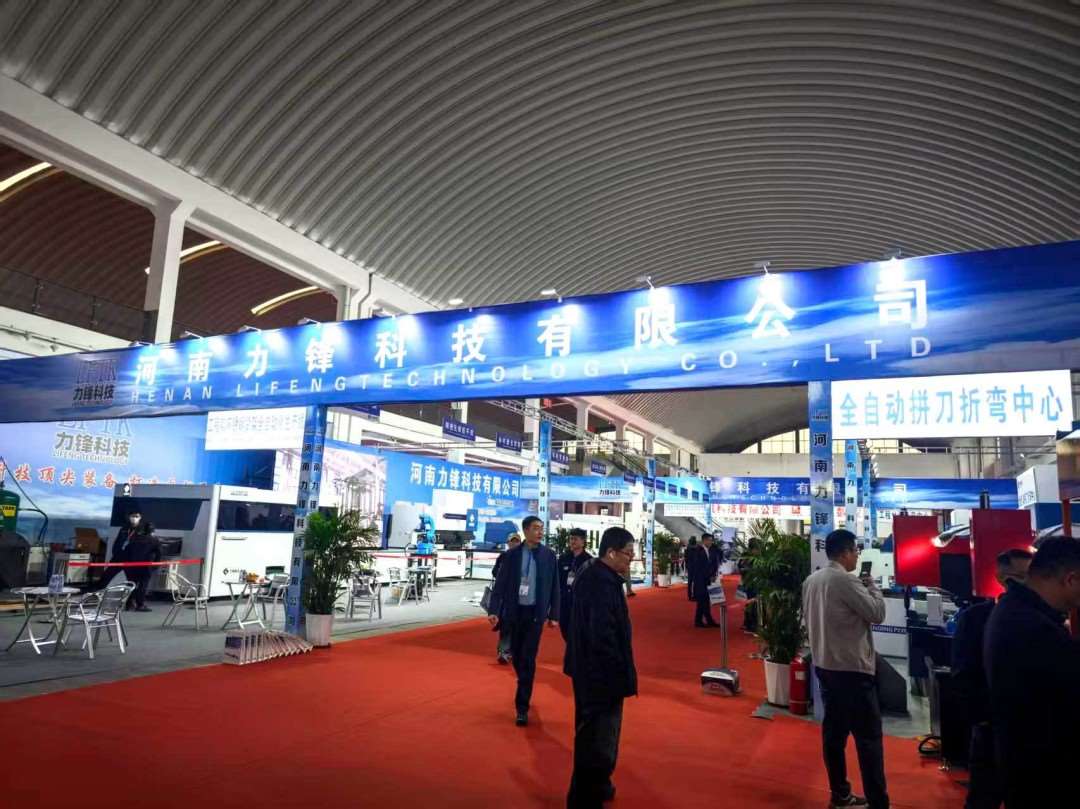
The Lifeng stand on the opening morning, with the automatic bending centre sign above the entrance.
Why kitchenware is moving toward automated lines
Stainless steel kitchen equipment is awkward to make by hand. Most of it is 0.4 to 1.2 mm sheet, which marks easily and distorts when welded. The parts are large and hard to lift alone. And the surface is the product: a scratch on a work table top or a sink front is a reject, not a cosmetic issue.
Each of those problems has a mechanical answer. A robot that picks with vacuum cups and places instead of drops takes out most of the damage manual handling causes. A laser welder puts far less heat into a corner than MIG, which keeps a cabinet door flat. And once the line carries the panel between stations itself, a four-operator job becomes one supervisor plus a technician.
What is on the stand
The exhibit follows the production sequence instead of a machine list. A visitor can walk a blank from coil to stacked part.
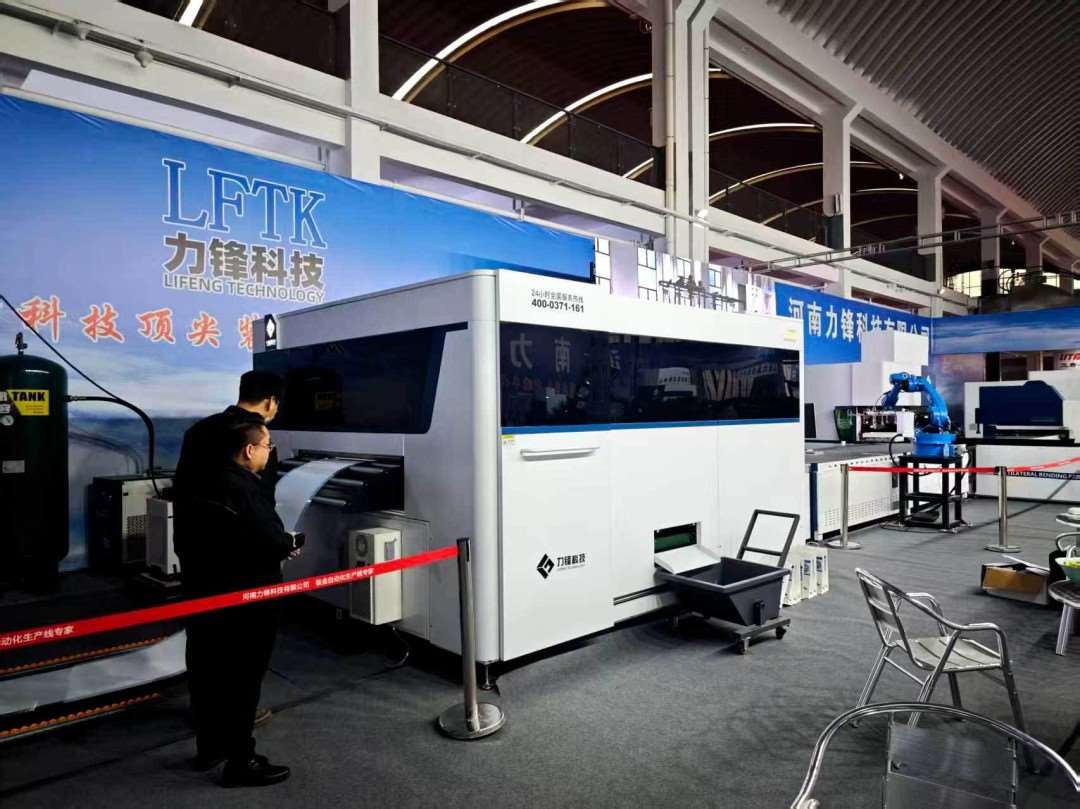
The laser cutting centre, with a robot arm for automatic loading positioned alongside.
Laser cutting centre
Blanks are cut on an enclosed fiber laser, with the cutting head, chiller and control cabinet in one footprint. Two details matter for kitchenware work. The nesting software decides how much of a 1,220 by 2,440 sheet ends up as product. The edge finish on stainless decides whether the next station can form the part without deburring; leave a burr and you find it later, first on the operator's gloves, then on a finished panel.
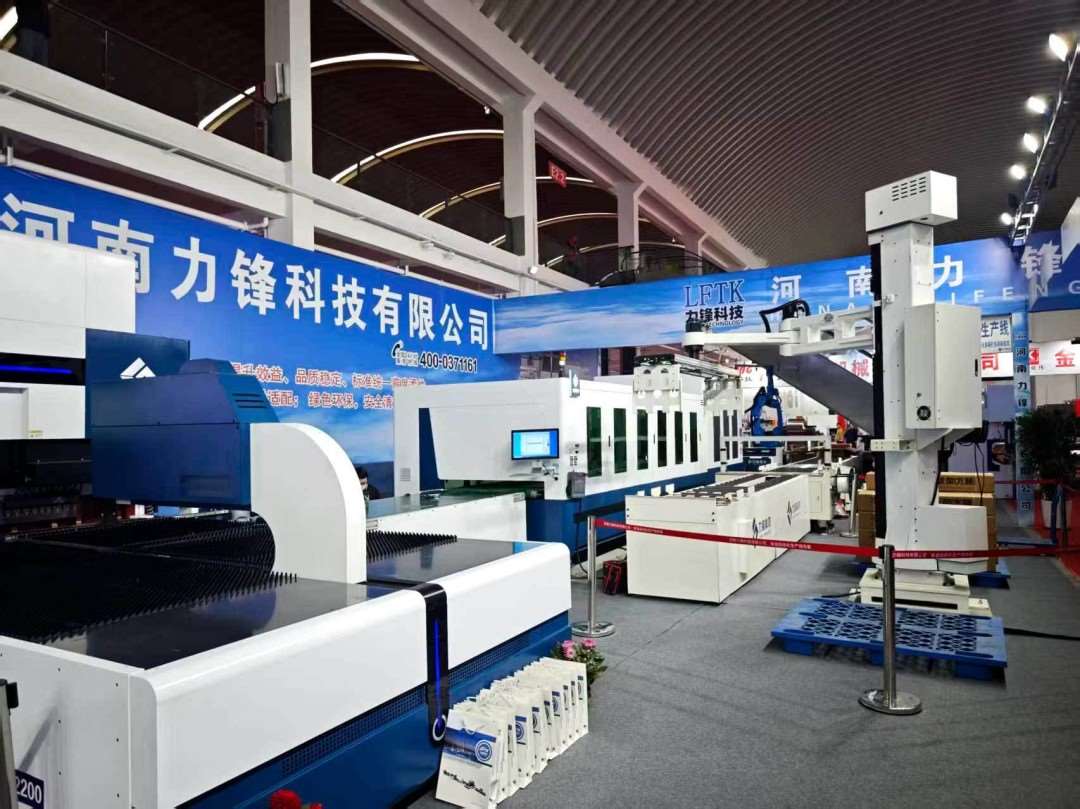
The forming area: a CNC bending machine in front, the enclosed line and its loading unit behind.
Bending centre
The sign over the entrance reads automatic bending centre, and this is where most visitors stop. The appeal is not speed alone; it is the elimination of the trial bend. Servo-controlled axes store the forming parameters for each part number, so a run of sink rims and a run of cabinet sides can share a shift without a tooling rebuild. A program change does the work. Run several hundred SKUs a month and changeover time becomes the number that decides whether the machine pays for itself.
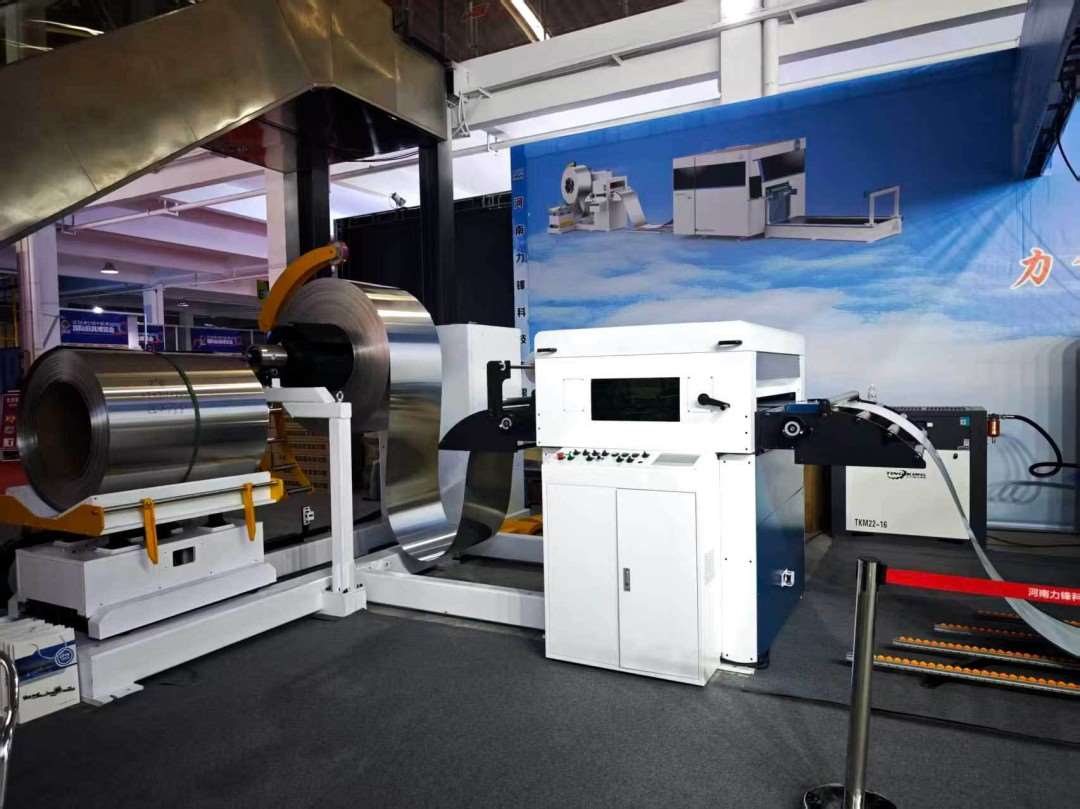
Decoiler and leveler: coil in, flat strip out, with the loop control between the two units.
Decoiler and leveler
Buying coil instead of cut blanks is the cheapest way to cut material cost and the quickest way to invent a quality problem. Coil arrives with a set from the winder, and a blank with a set bends to the wrong angle no matter how good the press brake is. The decoiler and leveler on the stand feeds strip through a straightening roll set, adds protective film where the surface needs it, and hands flat sheet to the line. Nobody photographs this machine. It's also the one behind a lot of flatness complaints filed two months after installation.
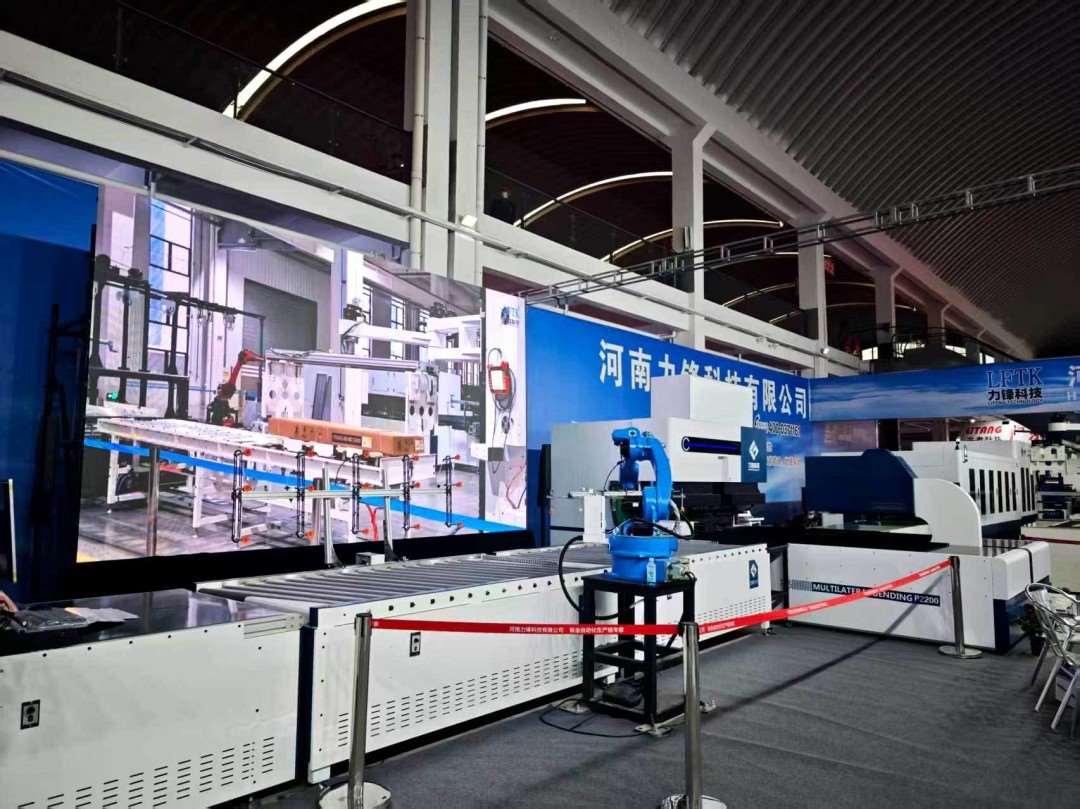
The robotic cell: automatic feed table, articulated arm and punch press working as one station.
Robot-served production line
The last station draws the most questions. An automatic feed table, a blue articulated arm and a turret punch press work as a single cell, with the robot moving blanks between them. The press on display is a third-party machine, and that's deliberate: most kitchenware plants already own their punch presses, so what they need is the automation around them, not a replacement. Wrapping existing machines is routine work here, as long as the control handshake and the safety circuit are designed at the start rather than bolted on afterwards.
What buyers are asking
Three questions kept coming back on the first morning.
Will the grippers mark a brushed finish? Vacuum cups on thin sheet, and a gripper that places instead of slides. Ask for a sample part under light before and after a full cycle. That settles it faster than any specification.
How long does a changeover take? Time it with a stopwatch on your own part. Quoted figures come off a table. Past twenty minutes, the line stops being flexible enough for mixed orders.
What happens to my existing machines? They stay. We build the line around the punch press, press brake or welder you already run, and the new automation handles the loading, transfer and stacking.
Visiting the stand
The expo runs through 28 October at the venue above. Engineers are on the stand for all three days. Bring a drawing or a sample part — thickness range, gripper choice and cycle time are much easier to answer with the actual part in front of the machine.
If you can't get to Boxing this week, send the part list and your monthly volume instead. We'll tell you which stations would earn their place in your plant, and which ones would sit idle.
PRE:
From 0.3 mm to 6 mm: Designing a Robotic Line Around Thickne...NEXT:
Lifeng Stand Fills Up on Day Two of the 21st China (Boxing) ...Copyright reserved©Henan Linfeng Technology Co., Ltd.